
Are We Psychologically Ready?
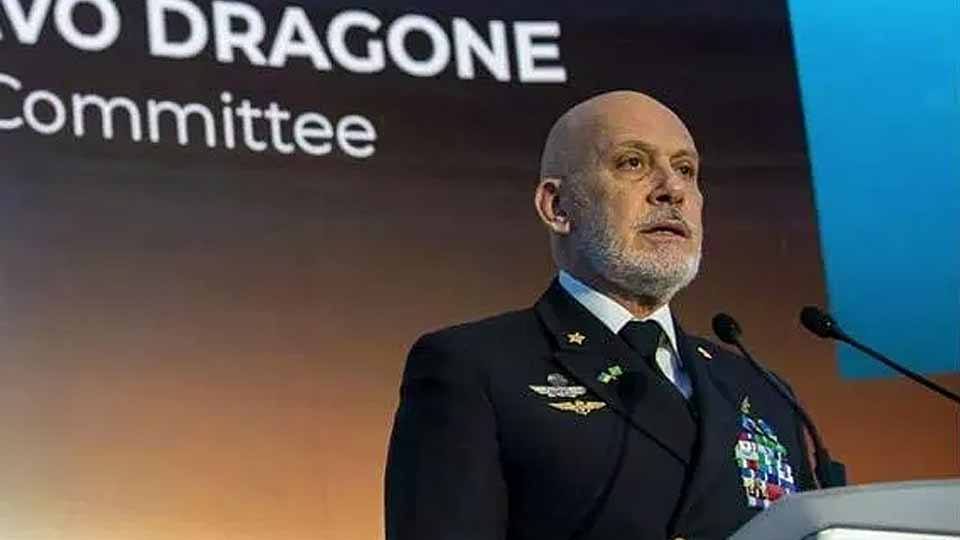 NATO’s outgoing military chairman, dmiral Giuseppe Cavo Dragone ,said “the weapons are ready” for conflict with Russia and that the alliance holds “4,000 pages” of war plans. Credit: NATO
Sept. 20, 2026 (EIRNS)—On Saturday the BBC reported “War May Be Coming” and asked the British public: “Are We Psychologically Ready?” Readers were told the government wants them to stockpile canned food and water and “plan for the possibility of war”; the piece closed by explaining how Finland and Norway run conscription. The same day the U.S. Secretary of War opened a national recruitment tour called “Send Me,” from Isaiah—“SEND ME TO GO FIGHT WHATEVER THREATS THREATEN OUR NATION.” In Paris, a three-hour intelligence briefing convened by President Macron left one party leader speaking of “vertigo.” In Copenhagen, NATO’s outgoing military chairman said “the weapons are ready” for conflict with Russia and that the alliance holds “4,000 pages” of war plans.
On Sunday, the German people whom these institutions were preparing to fight and die, went to the polls. In Mecklenburg-Vorpommern the Chancellor’s party, the CDU, lost all its seats in the state parliament while the AfD soared to the fore, and in Berlin the CDU lost to Die Linke. The winning parties disagree on much, but both oppose sending weapons to Ukraine. Two weeks earlier, Saxony-Anhalt had given the AfD 43.8%.
The institutions seek to prepare the people for war, and the people aren’t having it. But what will they have?
Speaking to the Indian Council on World Affairs in New Delhi on April 23, 1982, Lyndon LaRouche described the citizens of the industrial nations as decent, moral in their private lives, and “little”—unable to think past their families to the fate of nations. Such people, he said, do not evaluate policy; they “define their relationship to policy in terms of institutions—political parties, religious associations, trade unions, and so on. They allow these institutions to do their thinking for them.” Which means:
If they adhere to institutions which have bad policies, you can change the people only by reforming those institutions, or by causing them to become disaffected from those institutions if the institutions cannot be reformed. Therefore, the only time that you can produce what we might call a nonlinear change in the course of policies of nations are those conditions of crisis in which the little people themselves begin to question those institutions. Under those circumstances, if a people is inspired, great enterprises may be accomplished.
After citing his own 1946 encounters with Indians inspired to think about nation-building and the industrial development of their country, LaRouche cited Shelley: there are periods “in which the power for receiving and imparting profound and impassioned ideas concerning man and nature is increased.” That is what a peace-camp audience in Saxony-Anhalt meant two weeks ago when it told a Schiller Institute speaker who briefed the gathering on the BRICS and China, “your speech completely changed my narrow view.” It is what the president of the AFL-CIO meant this week when she said the Pope’s encyclical on human dignity “could have been a document written by the trade union movement.” Minds are open that were shut a year ago.
LaRouche continued:
However, also in such times of crisis there is a peril: lacking leadership for great enterprises, mankind will often turn itself into beasts. The same little people will destroy themselves. We saw that in Europe in the case of Mussolini’s Italy. We saw what happened to Germany.
People want to believe in something. “Send me to go fight whatever threats threaten our nation” is one identity on offer. Development, progress, railways, nuclear reactors, canals, and desalination plants are another.
This week both offers are on the table. The General Assembly opens in New York on Tuesday, with the host country having barred the Palestinian president and 152 states having voted to hear him anyway. On Wednesday the presidents of the United States and China meet in Washington. Their treasury chiefs spent all of today at JPMorgan’s headquarters in Manhattan and issued no statement as of this writing.
LaRouche’s 1982 proposal to the same India that hosted this year’s BRICS summit was that peace would not come from negotiation among parties who could not change their agendas, but from “creating the conditions under which peace negotiations are unnecessary.” The voters of two German states are the latest to have said what they do not want. What the people of the world are offered next is the question of the week.