
Extreme Danger: Escalation of Confrontation With Russia in Europe
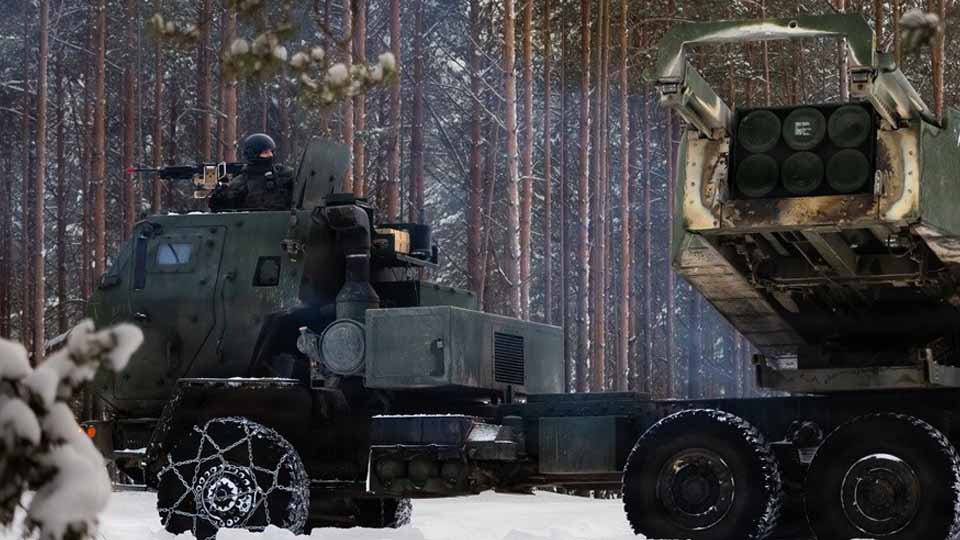 On July 2, Lithuanian President Gitanas Nauseda announced that his parliamentary leaders are favorable to changing their nation’s constitution, to allow foreign nuclear weapons to be stationed in Lithuania. Above: Lithuanian Armed Forces train as part of NATO collective defense. (Credit: U.S. Army)
July 4, 2026 (EIRNS)—In recent days, the escalation is extreme of Trans-Atlantic confrontation with Russia in Europe, not limited to bombast in the countdown to the annual NATO Summit July 7-8 in Turkiye, of the leaders of the 32 member nations. The stream of lies about how Ukraine is heading for “victory,” and Russia is weak, is incessant. But along with this come delusional threats of emplacing nuclear weapons on Russia’s border. Statements about this prospect came over the past 10 days from both Lithuania and Poland. Already in mid-June, the parliament in Finland voted to lift a decades-long national ban on nuclear weapons within its borders.
On July 2, Lithuanian President Gitanas Nauseda announced that his parliamentary leaders are favorable to changing their nation’s constitution, to allow foreign nuclear weapons to be stationed in Lithuania. The next day Nauseda stood proudly at a joint press conference in Berlin with the leaders Estonia and Latvia, alongside their approving host German Chancellor Friedrich Merz. Merz expressed his “respect” for Luthuania’s “political decision.” He said that it “demonstrates how seriously the threat from Russia is taken in that country.” He said that he takes note of how Lithuania is prepared, “to defend the country and thus also NATO territory.” On conventional forces, Germany intends to station its 45th Armored Brigade on a permanent base in Lithuania by the end of 2027.
On July 2 at the Pentagon, senior Polish official, Bartosz Grodecki, head of the National Security Bureau of the Polish Presidency, met with U.S. top officials, then afterward told reporters that there was, “enormous openness of the U.S. side” to Poland joining NATO’s nuclear sharing program. He gave no details, but said that discussions took place concerning “joining the program.” Additionally, he reported favorability to the U.S. establishing a permanent base in Poland, not merely rotating U.S. forces there
These moves for a nuclear ring-around-Russia, and forward basing of permanent joint NATO forces, are beyond delusional, they are the short road to thermonuclear holocaust. It is an urgent task for the wider world community to intervene with diplomacy, reason and truth.
Helga Zepp-LaRouche, founder and leader of the Schiller Institute, described these and other dangers, and urged action yesterday in her remarks to the July 3 International Peace Coalition. She called for “amplifying” the voices of reason, and announced that there will be “a new event of the IPC process, combined with an extended EIR roundtable event” soon. The tentative date has since been set for July 31. An announcement is forthcoming.
In the meantime, there are statements of note this weekend, on the occasion of the celebration of the 250th anniversary of the 1776 July 4 Declaration of Independence.
Russian President Vladimir Putin, in his message to President Trump today, congratulated the United States on its founding, “an important milestone in world history,” and wrote that Russia, then under the tsars, had “supported the North American colonists in their struggle for freedom from British rule.” His point rings true as a lesson for the present. Putin said that, “Today, Russia and the United States, as the world’s two largest nuclear powers, bear a special responsibility for ensuring global security and stability.”
Pope Leo XIV also today, had his letter to Americans (written June 25) released, in which he extends congratulations on the Declaration of Independence, saying, “This anniversary stands as an invitation not only to celebrate the nation’s remarkable journey, but also to reflect upon the responsibilities that the sons and daughters of this country bear to one another, and to the generations who will inherit the nation that is being shaped today.” He develops key concepts further, including the principle of the “God-given dignity of every human life,” that “guided the development of this country.”
A statement of appreciation of the positive impact in the Americas of the 1776 July 4 Declaration of Independence comes from Schiller Institute member Isabel Ramonet, who supplied a paper, posted on EIR.news, “Why We Also Celebrate July 5: The Collaboration of Patriots from Venezuela, the United States, and Mexico in the Pursuit of Happiness.” On July 5, 1811, was Venezuela’s Declaration of Independence. Again, another point that rings true as a lesson for the present.
For July 5, it is not too late to take advantage of the day-long marathon of essential history lessons organized as a public service (by pre-registration for in-person and online) of the campaign of Diane Sare, Independent candidate for President. The event is titled, “America 250: a Rededication.”
The words for the Fourth of July Independence Day, 125 years after the 1776 Declaration of Independence, given in celebration by then President William McKinley (in office 1897-1901), one of America’s “economic development” presidents, convey the commitment to intervene “for the right and true” that we must pursue today. (Speech in Woodstock, Connecticut, July 4, 1901):
“There must, I repeat, be a remedy for every wrong, a road somewhere and somehow to be found, which leads to righteousness. We can only pursue the right as it appears to us; the rest we can leave to others, and the ultimate victory may be nearer than we think. When Lincoln entered upon the execution of his great office in the turbulent year 1861, he had not formulated the immortal Proclamation of Emancipation. When Grant started upon his final campaign against Lee, in front of Richmond, he had not thought of that famous letter to the Confederate chieftain announcing the conditions upon which he would accept the surrender of the opposing army. Every great historical event in the world’s progress has had its preceding steps. Those who guided and directed could not always foresee with precision the outcome and the end; they only knew what seemed right and true to them, and on pursuing the right and truth, mighty epochs have been marked in the world’ s history, and mighty results achieved for mankind.”