
Literacy and Education: Public Education Should Produce Geniuses
Twenty-one percent of American adults cannot read this sentence. Eighty percent of American adults have not read a book in the last year. Most of the people whom we elect for public office are a tragic reflection of that problem. How did Americans become illiterate? See the introduction to this platform. Production requires a quality of critical reason, being a consumer only requires an opinion – usually someone else’s.
Like healthcare, it is impossible to reform the broken educational system outside of the context of a broader physical economic recovery. While there are always a few people so driven by a thirst for knowledge that even starvation wouldn’t stop them from learning, for mass public education, it is necessary that the young have a reasonable hope of being able to become a productive part of society, and to secure the means to provide for themselves and their families.
It is difficult to motivate the study of physics in a child who believes their future is to become a TikTok influencer, or end up sweeping floors at McDonalds, unable to buy a home in either case.
Once we have committed ourselves to a future of building beautiful new cities for a growing population, both here on Earth and on other heavenly bodies, we will experience an urgent need for a large number of young people who are creative scientific thinkers, as well as skilled artisans and builders. Below are the primary areas which Lyndon LaRouche believed should form the core of any public or private school curriculum.
Language. This means classical poetry and literature. Not merely Shakespeare, but English translations of the ancient Greek classics, Cervantes, Dante, Schiller, and Lessing. In addition, learning multiple languages opens the gateway to understanding the development of the human mind.
Universal history, as defined by German poet Friedrich Schiller. That includes American history, but also world history and geography, including study of the contributions of the great civilizations of Asia.
Plastic arts, including drawing, painting and sculpture. Work on perspective, and study and replication of discoveries made by artists such as Leonardo Da Vinci.
Physical science. Schools must have laboratories where experiments can be performed, and results measured. Students must have mastery of constructive geometry, and mathematics as derived from the physical domain. The work of Kepler, Gauss, and Riemann through Einstein and Vernadsky should be studied.
Classical music. According to Lyndon LaRouche, “Music should be presented as classical poetry sung according to principles of well-tempered polyphony. The basis for this is best established on the primary school level, by development of children’s choruses based upon a) the bel canto method of singing and b) strict adherence to a well-tempered scale set at middle C = 256 Hz,” Also, children will benefit both mentally and physically from learning to play musical instruments as soloists and in ensembles.
Every child deserves an opportunity to develop his or her mind, and to discover a passion for particular areas of science or art. A child educated according to this program has a good chance of becoming not only a productive citizen, but one who delights in the beauty of our universe, and the joy of discovering principles which allow us to participate in its unfolding development.
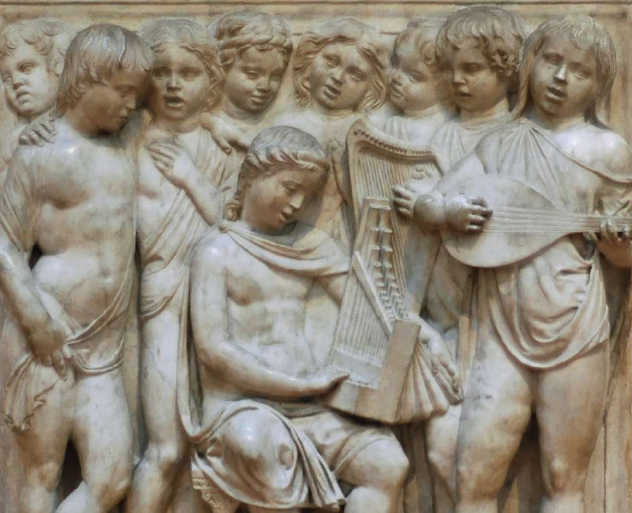 Sculptor Luca della Robbia (1400-1482) depicted these children singing in the "bel canto" form developed in the Italian Renaissance.