
Look East, Young Man!
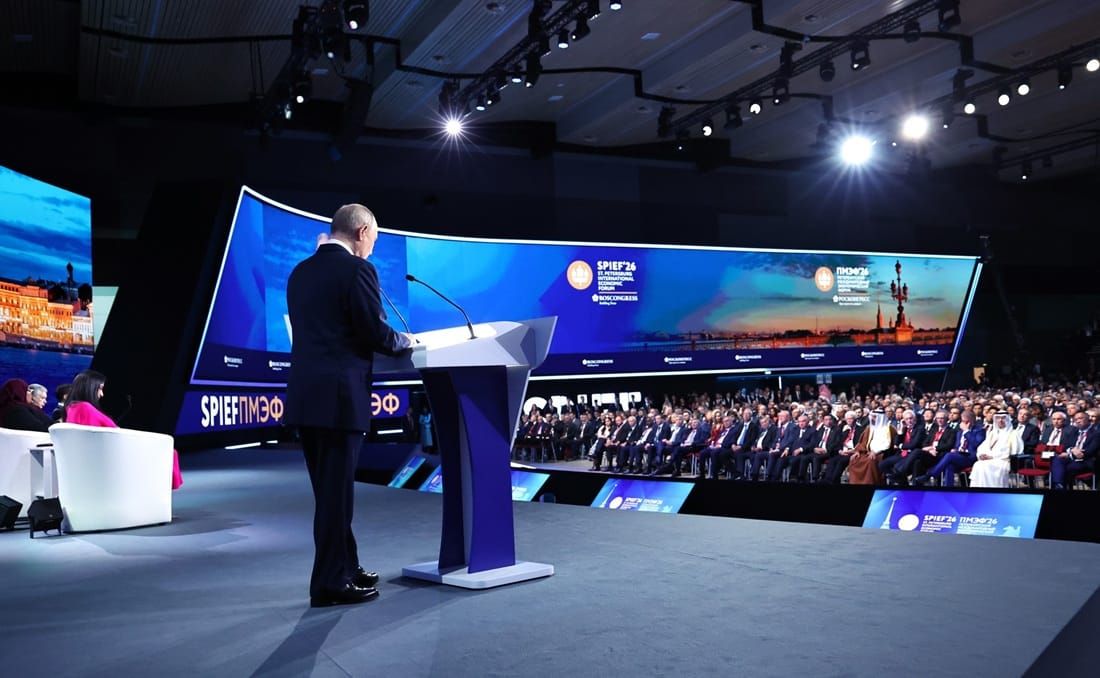 President Vladimir Putin addresses the St. Petersburg International Economic Forum. Credit: kremlin.ru
June 5, 2026 (EIRNS)—The reader will find that today’s edition of EIR’s daily news report is dedicated largely to developments occurring at or around the June 3-5 St. Petersburg International Economic Forum (SPIEF), a yearly event sponsored by the Russian government to bring together government, business and other leaders from around the world, to analyze the current strategic situation and foster East-West economic cooperation on a grand scale. This year’s conference gathered about 20,000 delegates from 130 countries.
Our focus here on SPIEF is intentional: it is where solutions to the world’s woes are being discussed. And if we, the people of the United States and Europe are to find our way out of the morass of permanent wars and cultural degradation (and the pessimism it fosters) that today beset us, it will only be by looking east, to the coming Eurasian world.
In his keynote address to the FIESP plenary session June 5, Russian President Vladimir Putin painted a stark picture of the coming demise of the current speculative system:
“The world (is) undergoing the largest structural transformation in decades,” Putin stated. "This transformation is not a transition from one phase of a cycle to another. We are witnessing a change in the paradigm of global development…
… For decades, the global development model was built around a limited number of financial centers, technological solutions, insurance and logistics hubs, credit rating agencies, and reserve currencies… It was increasingly used as a tool to exert political pressure and promote unfair competition, where settlements, technologies, logistics, or even access to information could be cut off at a moment’s notice in order to punish those who chose to act in their own national interests. In essence, it was a deliberately created system of dependency and resource extraction."
Later in his plenary remarks, Putin turned to sketch out the needed replacement architecture for this defunct system.
“Settlements in national currencies are developing, and new corridors are opening up. In Eurasia, these include the North-South Corridor, the Trans-Arctic transport route, and connections via the Caspian Sea, Central Asia, the Black Sea, and the Far East. All these projects and logistics routes are tangible features of today’s and, importantly, tomorrow’s development……Clearly, given the circumstances, countries around the world are taking their assets out of the West and shifting to payments in national currencies, increasingly using alternative payment systems.”
“Importantly,” Putin emphasized, “the world needs modern, flexible and responsible financial architecture without risks, prohibitions or barriers, but with incentives for sovereign development.”
Putin, like his close strategic ally President Xi Jinping of China, continues to extend a hand of cooperation to the West, and in particular to the United States, to participate in this emerging new architecture. One of the emblematic joint projects discussed on the sidelines of SPIEF is the construction of a tunnel under the Bering Strait that today separates Russia from Alaska—a massive project which, Russia authorities announced at SPIEF, is proceeding to the engineering design stage, and which China has been invited to join.
This is one of the flagship great projects long proposed by American statesman and leading physical economist Lyndon LaRouche. For him, the Bering Strait Tunnel project was part of a broader strategic conception which he presented in numerous locations, including his Nov. 2005 treatise, “TOWARD A SECOND TREATY OF WESTPHALIA; The Coming Eurasian World”:
“There are solutions; but, do not deceive yourself into imagining that I am proposing that we could simply turn back the clock to the better times of European civilization’s earlier decades as easily as simply reversing the relevant worst policy-decisions of the recent four decades. You can not relight the candle you have just burned up. It is time for some of us to come together to address the new kinds of deeper challenges facing us now in our future, as not only a nation, but as a world civilization. We must assemble quickly, to study the coincidence of this crisis with other, onrushing changes which also have the character of planet-wide social-political upheavals of tectonic implications.
“With the present systemic breakdown of that imperial, Anglo-Dutch Liberal system of finance which has dominated the planet increasingly since the February 10, 1763 Treaty of Paris, only an appropriate new system, replacing that Liberal system, could prevent the rapid descent of the planet as a whole into a new dark age. Therefore, we must now quickly craft and adopt a new system of relations among all of the leading sovereign nation-states of this planet, a treaty coherent with the principles of the 1648 peace Treaty of Westphalia. This requires a fresh view of the relations between peoples of, respectively, European and Asian cultures. Responsible people must now push forward, urgently, with the discussions needed to define the outlines of the needed direction of agreements.”
LaRouche emphasized then, as do we today: “I shall argue the case for an equitable global treaty arrangement among both nations based upon European civilization and the Asian and other cultures which represent the remaining cultures of the planet.”