
The Schachtian Dilemma: Conquer Or Collapse
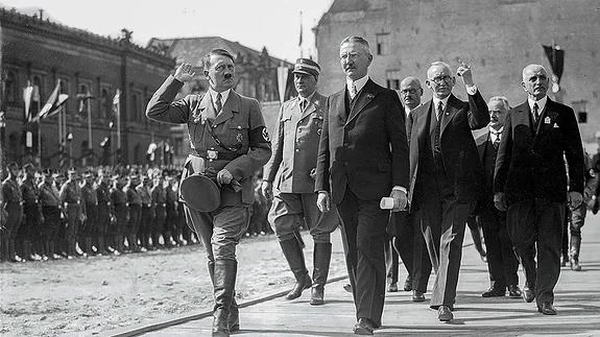 Back in the 1930s, Hitler’s Central Bank president Hjalmar Schacht decided to issue large quantities of worthless, government-backed MEFO bills to fund massive German rearmament—and the result was the Eastern Anschluss and the concentration camps. Above: Hitler and Reichsbank President Hjalmar Schacht on the march in 1934.
June 3, 2026 (EIRNS)—The overriding theme of the just-concluded Schiller Institute conference in Berlin, Helga Zepp-LaRouche explained in her weekly webcast today, was the “unbelievable indifference” being shown by most European governments to the extreme danger for all Mankind that their own actions have created by driving relentlessly for war with Russia—a war which will inevitably be nuclear, if not prevented. She further denounced the June 3 Ukrainian drone attack on St. Petersburg, Russia at exactly the time that the yearly St. Petersburg International Economic Forum was getting underway. “This is beyond reckless; it is criminal,” Zepp-LaRouche insisted, warning that the attack may well backfire politically against Kiev, given that there are some 20,000 participants from over 100 countries attending the three-day forum.
What is driving such madness?—one rightly demands to know.
The Western financial-strategic situation is approaching a boundary condition. According to the Stockholm International Peace Research Institute (SIPRI), global military spending reached nearly $2.9 trillion in 2025, which comes out to more than 2.5% of global GDP—the highest level since 2009. About one third of the total amount—$954 billion—was spent by the U.S., and President Trump has vowed to increase U.S. defense spending in 2027 to $1.5 trillion.
The New York Council on Foreign Relations, the elite Establishment think tank, has just published a worried article about where this massive military spending is heading and how it can be maintained, headlined “Beware the Costs of the Global Rearmament Boom.” The article notes that “roughly two-thirds of recent national boosts in defense spending were deficit financed, and that the average recent defense spending ‘boom’ was followed by an increase in the country’s fiscal deficit of about 2.6 percentage points.” This, along with the out-of-control inflation unleashed by Trump’s other incompetent economic policies, has meant major pressure to increase interest rates, which is further worsening government budget deficits. The CFR piece then reports that “IMF Managing Director Kristalina Georgieva noted in April, (that) such a policy combination in the current fiscal environment could end badly. She compared it to having one foot on the accelerator and one on the brake: ‘It’s not a good way to drive a car.’”
This is not the first time such criminal insanity has been visited on the world. Back in the 1930s, Hitler’s Central Bank president Hjalmar Schacht decided to issue large quantities of worthless, government-backed MEFO bills to fund massive German rearmament—and the result was the Eastern Anschluss and the concentration camps.
This same Schachtian policy is being implemented today, and it has become a runaway freight train heading towards a cement wall—especially in the United States. Interest payments on the $39 trillion U.S. government debt are already consuming $1 trillion per year from the federal budget; the debt will be growing even more rapidly than it has until now, especially with Trump’s proposed $1.5 trillion defense budget; and interest rates are now set to increase, not decrease—despite all of Trump’s yelling and hollering, placing Kevin Warsh at the Fed, and so on. Will the United States soon be spending $2 trillion on military expenditures, paying another $2 trillion on interest payments, and watching the debt soar to $50 trillion?
And under these conditions, how in the world can the City of London and Wall Street bankers keep their massive global speculative bubble of $2.4 quadrillion from exploding? That question, and its answer, explains the current foreign and economic policies of the United States and Europe—and also points us in the direction of the needed solution.