
Development Is the New Name for Peace: The Summit That Should Be
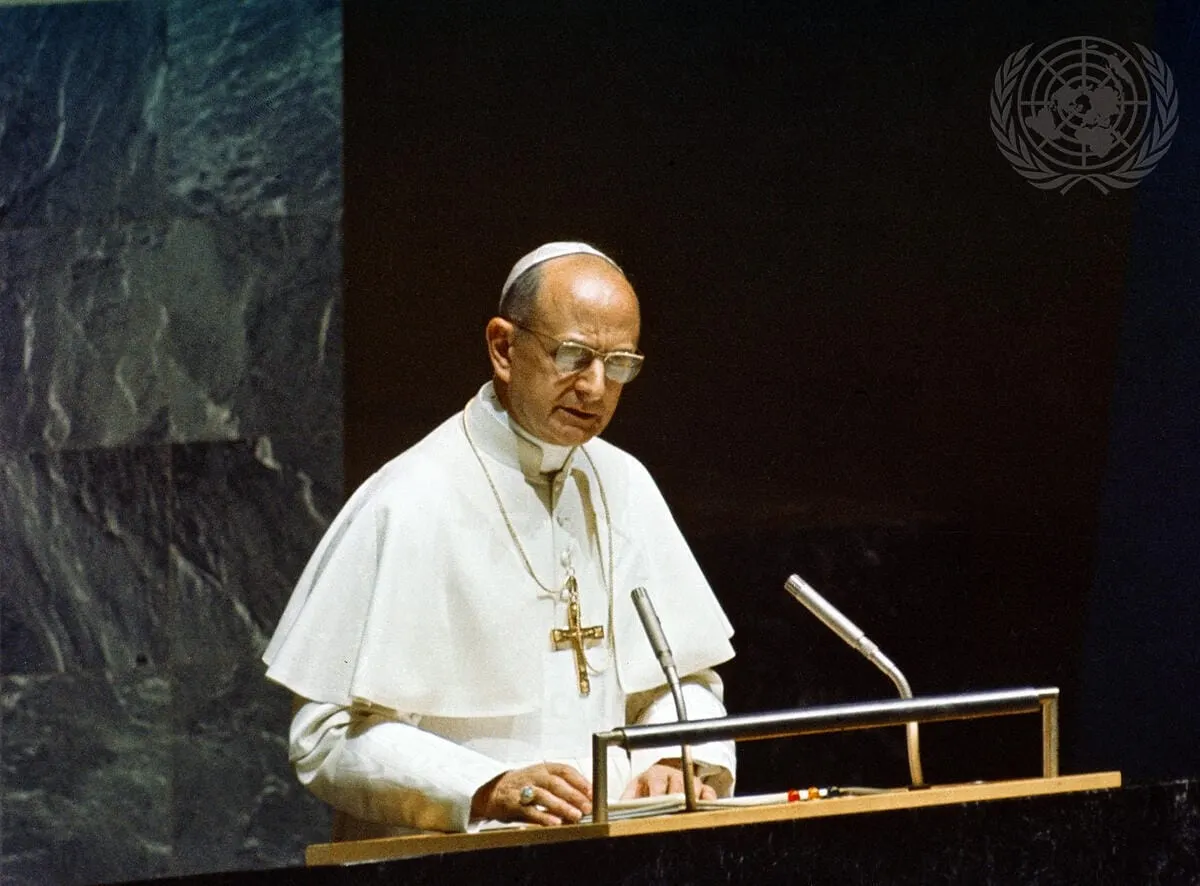 Pope Paul VI addressing the United Nations in 1965. In his Populorum Progressio, he wrote that development is the new name for peace. Credit: UN Photo/Teddy Chen
Aug. 20, 2026 (EIRNS)—In October 1965 Paul VI became the first pope to address the United Nations General Assembly. He quoted an American president murdered less than two years earlier: “Mankind must put an end to war, or war will put an end to mankind.” He cited Isaiah on beating swords into plowshares. Two years later, in Populorum Progressio, he wrote that development is the new name for peace.
Peace is not the absence of shooting, not the equivalent of “no war.” It is the presence of something being built. A society or world that has stopped building, has abandoned the uniquely human calling to be fruitful and multiply, and will become prey to the entropic forces of conquest.
Leo XIV has repeated his predecessor’s appeal himself. “It is not atomic weapons that generate peace, but disarmament,” he said earlier this year—a truth that “seemed clear in past decades when we witnessed a nuclear de-escalation,” but which “has been obscured by a race to armament that today frightens and terrifies.”
On Aug. 19 an open letter was released asking him to act on those words: to convene an emergency summit of the world’s leaders, “including the heads of state of the three principal nuclear powers.” The precedent it names is John XXIII in October 1962, whose intervention between Kennedy and Khrushchev is credited by participants on both sides with helping open a way out of the Cuban Missile Crisis.
What would a tripartite summit have to take up?
The rules governing the conditions under which the United States would use a nuclear weapon are being rewritten right now, in a document Congress will not vote on and no citizen will ever read. Elbridge Colby confirmed it to The Washington Times on Aug. 18: the Pentagon is re-examining nuclear employment guidance to give the President “rational nuclear options” in a regional war. The Department chose a “nuclear strategy review” rather than a Nuclear Posture Review precisely because the latter must be published. In a 2015 paper Colby argued that the capacity to fight a limited nuclear war “would give the United States coercive leverage” over its opponents. Every scenario ever run on that premise ends the same way: one weapon, then a general exchange, then a nuclear winter and mass starvation.
Alongside it sits a $1.2 trillion program that Congress’s own auditors have never received a briefing on by the Department of War. “I know nothing about what they’re actually building,” CBO’s David Mosher said Wednesday of Trump’s Golden Dome. No treaty constrains the world’s two largest arsenals. The established nuclear powers are maintaining or expanding their arsenals and capabilities, and Japan, South Korea, Poland, Saudi Arabia, and Ukraine have discussed building arsenals of their own.
And the institutions built to restrain any of this are being taken apart from both ends. The United States has sanctioned Tomoko Akane, the President of the International Criminal Court, for the Court’s warrants against Netanyahu and Gallant—punishing the judge to protect the accused. Meanwhile Moscow and Beijing have reached back to the UN Charter’s “enemy state” clauses against Japan. And in Israel, a sitting minister has published a gloating video of a gallows complex under construction, to be fitted with viewing booths.
Where does this trajectory end?
Helga Zepp-LaRouche put it in historical context on Pakistani television Thursday. The Peace of Westphalia ended 150 years of religious war only after a third of everything in Europe had been destroyed and every party understood that no one would be left to win. What the exhausted powers then wrote down was the principle that peace requires taking account of the interest of the other—all others. Exhaustion alone produced nothing. Exhaustion plus an idea of the future produced Westphalia.
An idea of the future exists today, in the proposals of the LaRouche movement for a World Land-Bridge and as demonstrated by developments stemming from mankind’s uniquely creative nature.
As early as Monday, China plans to launch Chang’e-7 toward the south pole of the Moon, carrying a probe designed to leap into craters where sunlight has not fallen in billions of years, to find out whether human beings can live there. Six of its instruments are not Chinese—among them a hyperspectral imager built jointly by Egypt and Bahrain. This week Merck and Moderna reported the first Phase 3 result ever obtained for an individualized cancer therapy technique: not a drug, but a method for manufacturing a different medicine for hundreds of patients. Next month a canal opens in Guangxi, three months early, that shortens by up to 560 kilometers southwestern China’s distance to the sea. And one day after Israel bombed a Syrian airbase, Türkiye’s energy minister was in Damascus signing an agreement on phosphate mining and a railway to carry the resource to port.
Forces organizing around an idea for the future will assemble Friday at 11 a.m. Eastern in the International Peace Coalition, convened by Zepp-LaRouche. Circulate and solicit high-level signers to the appeal to Pope Leo, and bring someone new to the meeting.