
The World Needs Glass-Steagall Bank Separation NOW!
PDF: The World Needs Glass-Steagall Bank Separation NOW!
After the crash of 2008, rather than address the cause of the crisis – namely that the entire transatlantic financial system was a speculative bubble which could never be saved – the governments of the United States and Europe decided to issue one multi billion dollar/euro bail out after the next, which allowed a handful of individuals to get very rich, and the largest banks to get even larger, while the people of Europe and the United States paid for it by skyrocketing cost of living increases.
We are now headed for a systemic collapse of far greater magnitude than the 2008 crash. Attempting to save this bankrupt system is folly. It must be reorganized, starting with reenacting the FDR-era Glass-Steagall Act, and similar bank separation worldwide.
The LaRouche movement is launching a worldwide mobilization to separate the banks, and to return to a fixed-exchange rate system to protect actual physical economic growth and not the parasite- billionaires.
In the United States, this means getting the Congress to act to reinstate Glass-Steagall, and pressuring them by taking the information here to every city council, and state legislature in the nation.
Below is a fact sheet prepared by EIR economics editor Paul Gallagher.
1. Reorganization of the Commercial Banks
From the 2007-08 global financial crash until the early 2020s, the loans-to-deposits ratio in the United States banking system as a whole went from 102% to 60%; and in the biggest six “Wall Street” megabanks, from approximately 85% to approximately 40%. The rest is speculative investment, including these banks’ ownership of, and prime broker services to, thousands of hedge funds, money-market mutual funds, etc.
Deposits and Loans in the U.S. Banking System
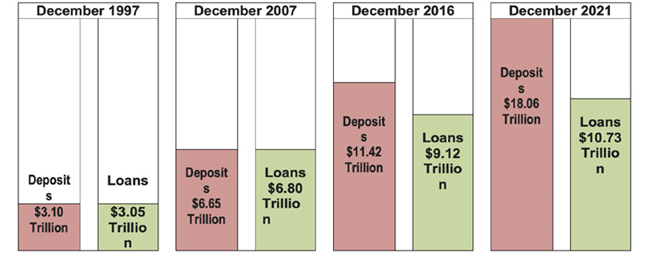
These are no longer commercial banks, lending banks; they are investment banks speculating with customers’ deposits.
Glass-Steagall will prohibit this. The banks will have a Congressionally determined period, of perhaps six months or a year, to sell off or separate all securities speculative divisions (of which the largest banks each have several thousand), leaving those entities with no prospect of Federal government, FDIC or Federal Reserve bailout if they fail, as most of them likely will.
2. Separation from Securities Broker-Dealing
Commercial banks, no matter how large, will be limited to the business of depositary services and lending, as well as services incidental to commercial banking such as currency exchange, or purchase and redemption of government securities for customers. They will specifically be prohibited both from owning, and from lending to funds for the purpose of securities broker-dealing; and from dealing in the markets for financial derivatives contracts.
3. Holding Companies
Commercial bank holding companies which own commercial banks will be prohibited from owning investment banks, or from owning commodities dealers which hold and speculate in primary commodities essential to the economy, including energy and electricity.
4. Building the Real Economy
The dismal ratio of loans to deposits in the big banks is directly connected to the Federal Reserve Bank—a central bank which lends to no one, while pumping deposits into those megabanks, making them 50% larger since the 2008 crash. Those banks, in turn, use the deposits to speculate rather than lend.
Therefore a reinstated Glass-Steagall Act, which dries out that massive of speculative debt bubbles dominating the banks, sets the stage for real economic recovery. The economy needs credit for infrastructure projects, reindustrialization, and to participate in economic development abroad. It needs a Hamiltonian national bank, capable of lending trillions of dollars productively, and created by nationalizing the Federal Reserve and completely changing its mission.