
What Order Feeds Wars More Readily Than People?
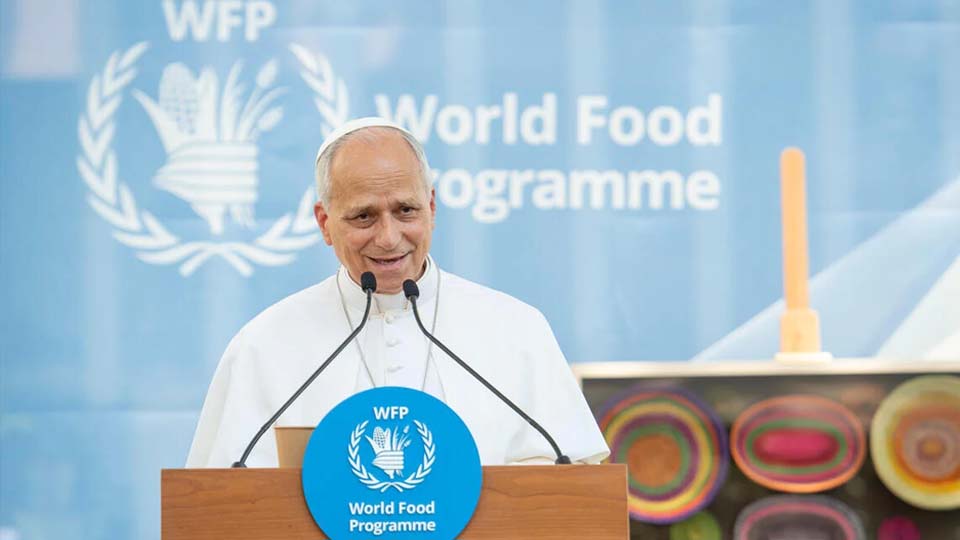 His Holiness Pope Leo XIV addresses staff during his visit to the World Food Programme Headquarters in Rome, Italy. Credit © WFP/Giulio d'Adamo
June 23, 2026 (EIRNS)—Addressing the United Nations’ World Food Program in Rome on Monday, Pope Leo XIV said the world “could live without hunger”—the food exists, the capacity exists—and yet the resources go to war, so that “conflicts are ‘fed’ more readily than people are nourished.” He went beyond a call for more aid. He asked instead why the catastrophe keeps returning: “what configuration of the global order is capable of producing, reproducing and… normalizing such conditions?”—why the system “constantly produces the very problems it is then forced to correct.” Beneath all of it, he said, lies one moral fact: “the human person is no longer consistently placed at the center.”
Here’s one answer to his question: In Lebanon, the UNDP this week counted more than 11,000 buildings destroyed and 963,000 people—one Lebanese in six—driven from their homes, even as Benjamin Netanyahu maneuvers through his envoy Ron Dermer to keep the bombing license open and the U.S.-Iran deal from closing. The human person, removed from the center; the catastrophe, reproduced. What configuration of the global order allows this to occur?
But the Pope’s question has another answer, being given by those building a different configuration. In New Delhi this week the security chiefs of eleven BRICS nations met; on its sidelines, China’s Wang Yi and India’s Ajit Doval advanced the normalization of relations between the world’s two most populous nations, preparing the next round of talks to settle their long-disputed border. And the bloc’s long-discussed commodity exchange—a Russian-led effort to clear trade in grain and other goods outside Western-controlled markets—is moving from idea to design, with a work plan due by July 1, Interfax reports.
Proof that human reason can build on the scale of centuries rather than election cycles is seen in the JUNO detector measuring neutrinos, the publication of a catalogue of 390 gravitational wave events, and the new Vera Rubin telescope mapping thousands of asteroids no one had ever seen.
Set against that, the destroyers’ program is plain. Germany’s chancellor buys a 40-percent stake in the tank-maker KNDS and tells his assembled bankers the statutory pension is finished, the better to fund rearmament; the U.S. Army stands up a new Pacific command built, in plain terms, for war on China. The inheritance of centuries—including the anti-colonial acts of the United States—is being treated as a fund to be drawn down with no end in sight.
The choice the Pope named is ours, and the calendar is short. On June 23, New Yorkers vote in their primary—among them Congressional candidate Jose Vega, who also holds a line on November’s ballot as an independent. This Friday the International Peace Coalition mobilizes.
“We understand the laws of the universe,” LaRouche wrote, “only to the degree that we are able to impose our will to alter the course of that universe”; and because our discoveries outlive us, “the transmission of valid cognitive ideas of principle, across many generations,” is the individual’s “access to immortality.” A republic transmits an idea the same way. The United States, about to turn 250, was once the great anti-colonial republic—and can be again.
On July 3 Pope Leo receives the Liberty Medal in Philadelphia, and on July 5 Diane Sare’s “America 250: A Re-Dedication” follows, marking the 250th anniversary of the Declaration of Independence with a challenge to shape the future of the nation.
The system reproduces catastrophes only so long as we permit it. Which configuration will we instead place at the center?