
Who is Lyndon LaRouche?
Lyndon H. LaRouche, Jr., (1922–2019) was a true American genius, whose voluminous writings and policy initiatives are largely unknown by Americans under the age of 70 because of a concerted campaign by the enemies of our Republic in the mainstream media and foreign and domestic intelligence agencies to suppress each of his eight presidential campaigns and railroad him into federal prison for five years on phony charges.
LaRouche's unique standing as the most successful long-range economic forecaster of the post-WWII period grew out of his original discoveries of physical principles through his studies of Gottfried Leibniz and Bernhard Riemann. The central feature of LaRouche's activities and method was his emphasis on the sovereign cognitive powers of the individual human mind, typified by validated discoveries of physical principle, and by great classical compositions in music, art, and poetry. This scientific method led to the formulation of his “LaRouche–Riemann” economic model which was uniquely able to measure real, physical economic progress as a product of human scientific discovery and its application through machine tool design and technology.
LaRouche rose to public prominence after he forecast that the Nixon Administration was about to dismantle the Bretton Woods system by decoupling the U.S. dollar from gold, which was in fact done in August 1971.
In 1975, LaRouche proposed what he called the International Development Bank, with the goal of strengthening the world economy through long-term, low-interest credit for development projects and capital-goods exports to the underdeveloped sector. LaRouche and his wife Helga Zepp-LaRouche (m. 1979) traveled the globe, meeting with leaders in dozens of nations, including Prime Minister Indira Gandhi of India, President José López Portillo of Mexico, and many others, in an attempt to organize a bloc of nations to declare a debt moratorium and put the criminal global banking institutions out of business.
LaRouche and the Presidency
In response to the acute danger of thermonuclear war stemming from the insane Anglo–American establishment policy of using the threat of nuclear war as a means of maintaining political hegemony, Lyndon LaRouche launched his first U.S. presidential campaign against President Jimmy Carter in 1976. LaRouche would go on to campaign for the Democratic Party presidential nomination in 1980, ’84, ’88, ’92, ’96, 2000, and 2004.
LaRouche’s influence on the presidency became especially apparent on March 23, 1983, when President Ronald Reagan adopted LaRouche’s policy of achieving a new form of strategic defense on the basis of new physical principles such as laser defense—the “Strategic Defense Initiative”—a policy explicitly designed by LaRouche to bring an end to Henry Kissinger’s “Mutual Assured Destruction” (appropriately abbreviated MAD). For months, LaRouche served as the Reagan Administration’s unofficial back channel to Soviet representatives in negotiations regarding the SDI. After the unfortunate Soviet rejection of Reagan’s offer to collaborate on achieving the SDI, LaRouche forecast that this would lead to the bankruptcy and disintegration of the USSR within five years, a forecast which LaRouche underscored on October 12, 1988, in a public address where he boldly proposed the reunification of Germany a full year before the fall of the Berlin Wall.
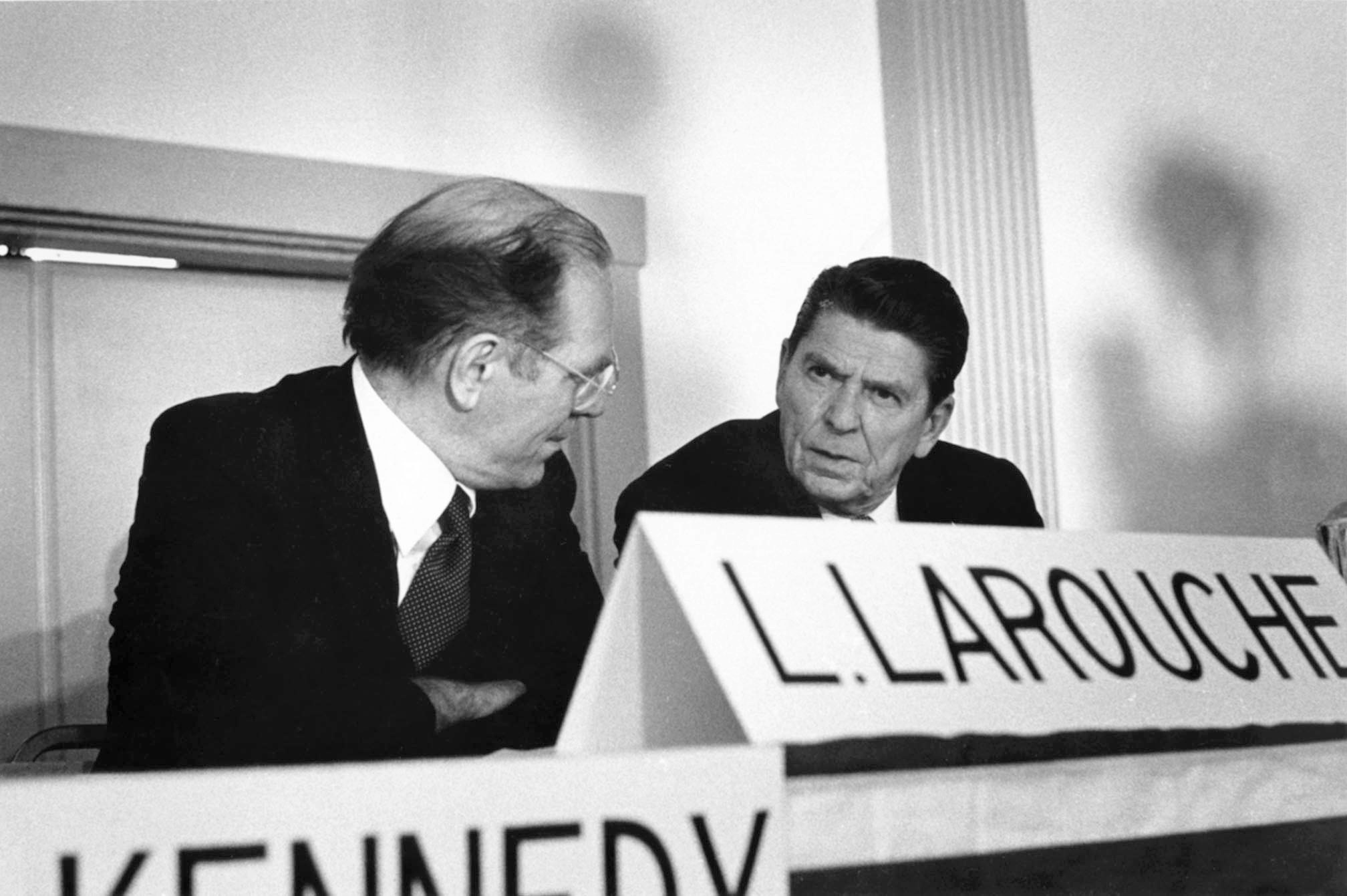 LaRouche speaking with future President Ronald Reagan at a candidates forum in New Hampshire during the 1980 presidential campaign.
‘Get LaRouche!’
Although the Anglo–American establishment drive to silence LaRouche went at least as far back as 1973, the effort intensified in 1982 as LaRouche’s activities and policy initiatives began to seriously threaten London and Wall Street’s control over the U.S. presidency. In 1982, Henry Kissinger sent a letter directly to FBI Director William Webster demanding action be taken against LaRouche. By 1983 private investment counselor John Train assembled a “Get LaRouche Task Force” which met at his Manhattan brownstone. This included Roy Godson, then a consultant to the National Security Council and the President's Foreign Intelligence Advisory Board; John Rees, a longtime FBI informant; Mira Lansky Boland, head of Fact Finding at the Washington, D.C. offices of the Anti-Defamation League of B'nai B'rith; at least one representative of Freedom House, a private research organization headed by PFIAB Chairman Leo Cherne; Richard Mellon Scaife, a wealthy Pittsburgh businessman whose tax-exempt foundation would later come under federal criminal investigation for illegally financing the arming of the Nicaraguan Contras; and several dozen journalists from major national media outlets, including NBC-TV, Reader's Digest, Business Week, The New Republic and The Wall Street Journal.
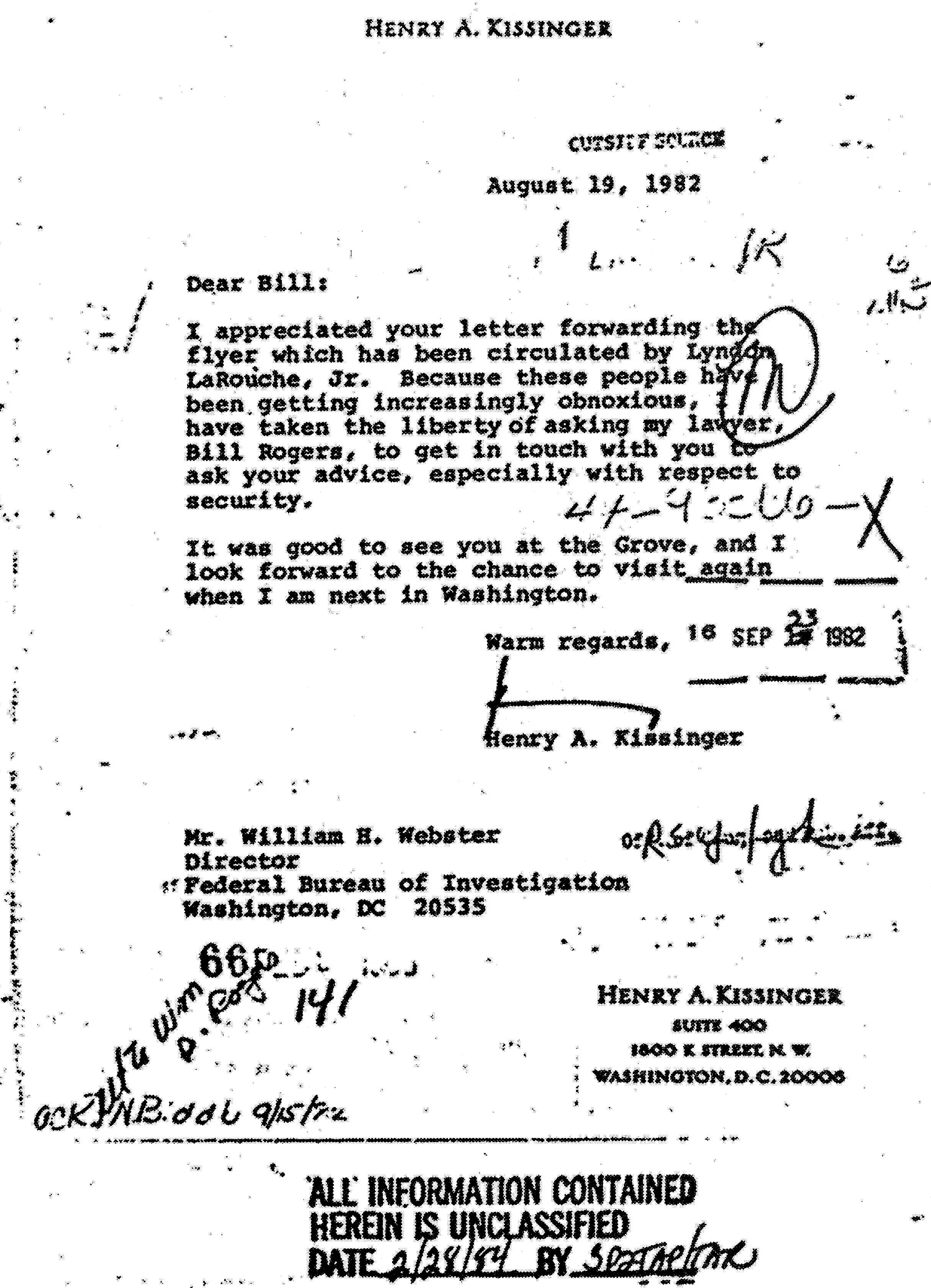 Kissinger’s now-notorious “Dear Bill” letter to FBI Director [William] Webster demanding action be taken against LaRouche.
On October 6, 1986, the Department of Justice ordered a massive raid on LaRouche’s Leesburg, Virginia home and offices, involving over 400 U.S. Marshals, FBI agents, county police and others, in what was later revealed through an FOIA request to have been an attempt to assassinate LaRouche. Although the assault on LaRouche’s home and person was called off by President Reagan (whom LaRouche had managed to contact during the raid), the ransacking of LaRouche’s offices, resulting in the seizure of thousands of pages of documents, and the “involuntary bankruptcy” (later overturned) of LaRouche-related periodicals, effectively terminated the LaRouche movement’s direct communication with hundreds of thousands of its American supporters. This included the shutting down of LaRouche’s Fusion magazine, one of America’s largest circulation scientific journals at the time.
Toward a New Paradigm
Despite the adversity of imprisonment and constant slander by the Anglo–American mainstream media, LaRouche and his wife Helga Zepp-LaRouche continued to fight for a new, just world economic order to replace the doomed post- Bretton Woods System. This included LaRouche’s proposal for what he called a Eurasian Land-Bridge, whereby rail and other infrastructure corridors would stretch like arteries into every corner of the world—something which had become possible with the collapse of the Soviet Union in 1991, the very collapse that LaRouche had forecast in 1983—and which is now in progress with China’s Belt and Road Initiative.
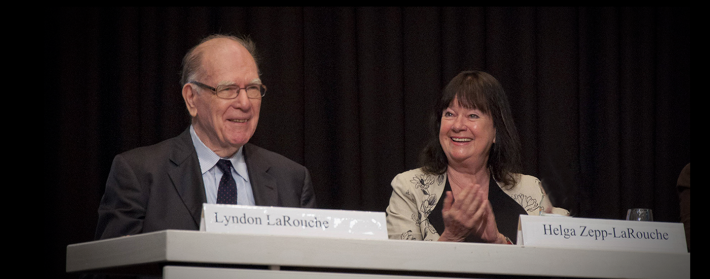 Lyndon LaRouche and Helga Zepp-LaRouche
President Trump: Exonerate LaRouche
The most effective pathway for President Donald Trump to crush the treasonous forces both inside and outside the United States which have lied us into war after war, and attempted to destroy his ability to normalize relations with the other major nuclear superpower, Russia, through the phony “Russiagate” witch hunt, would be to finally exonerate Lyndon LaRouche. This action would also end the suppression of LaRouche’s brilliant policy initiatives, which if adopted now, would allow the American people to experience the most amazing economic recovery ever in our history.